
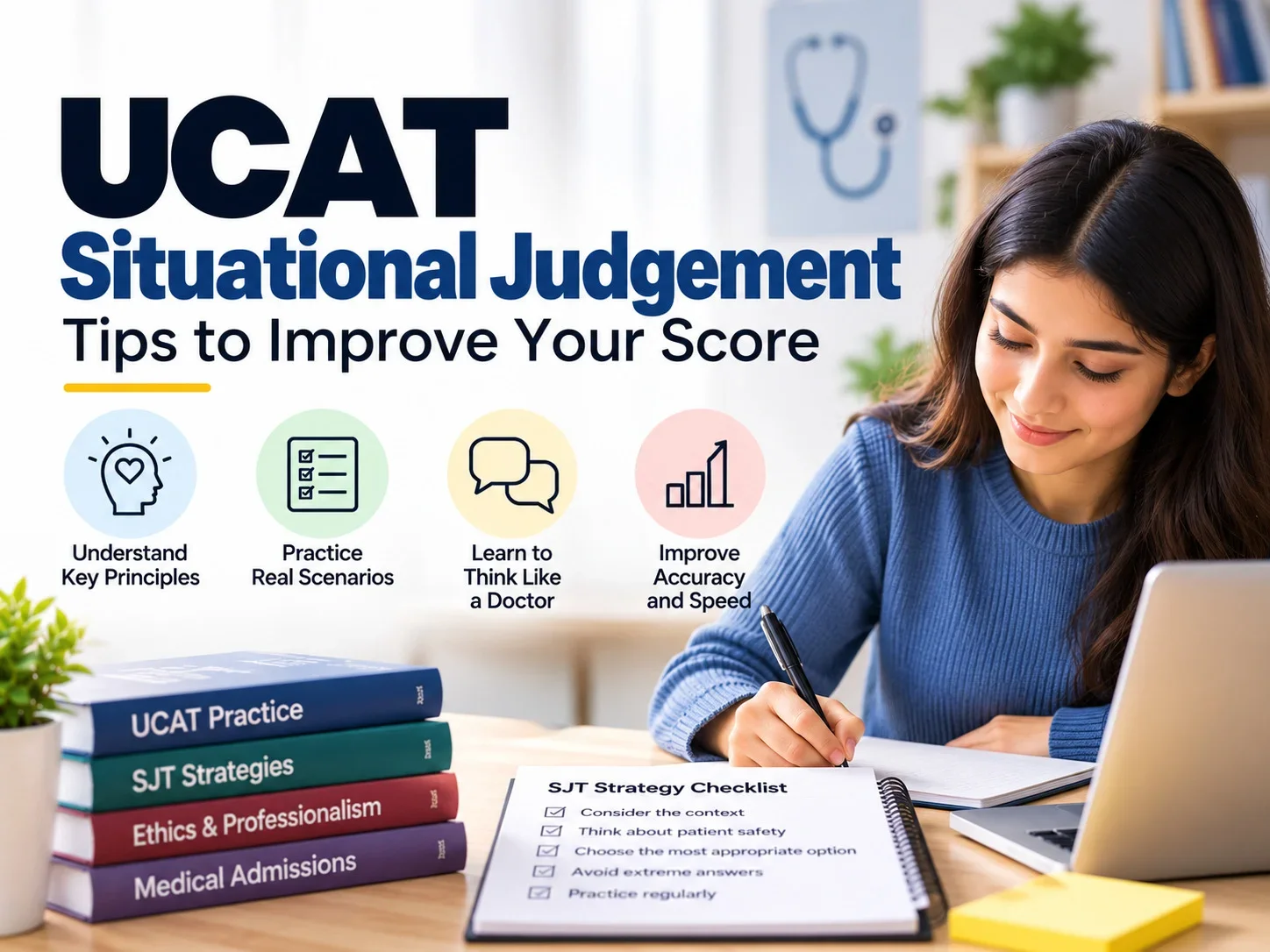
These UCAT Situational Judgement tips will help you improve in a section that students often spend the least time preparing for. Unlike other parts of the UCAT, Situational Judgement does not test factual knowledge or calculation speed. Instead, it assesses your ability to recognise appropriate responses to realistic healthcare and university scenarios.
With the right approach, you can improve your performance in UCAT SJT. This guide covers the test format, how it is scored, and the key principles that underpin the correct answers.
What UCAT Situational Judgement measures
The section assesses your understanding of how to behave in real-world situations, especially those involving patients, colleagues and professional responsibility. Universities use it because these qualities matter for safe and effective doctors and dentists.
UCAT SJT format
Situational Judgement has 69 questions to answer in 26 minutes. Each scenario is followed by several questions. Common question types ask you to:
Rate how appropriate a response would be.
Rate how important a factor is when deciding what to do.
Choose the most and least appropriate actions from a list.
How UCAT Situational Judgement is scored
You receive full marks when your answer matches the correct answer, and partial marks when your answer is close. That means a "nearly right" answer still earns something, so never leave a question blank. Situational Judgement is scored separately from the three cognitive subtests.
Think like a doctor
Most correct answers follow a small set of professional principles:
Patient safety comes first. Any action that puts a patient at risk is inappropriate.
Honesty and integrity. Covering up mistakes or misleading others is never appropriate.
Know your limits. Students and junior staff should seek help from someone more senior when needed.
Respect and confidentiality. Treat patients and colleagues with respect and protect private information.
Teamwork. Raise concerns sensibly and directly before escalating.
UCAT Situational Judgement tips that improve your score
Read the scenario carefully and note your role in it, for example a medical student or a junior doctor.
For appropriateness questions, judge each response on its own rather than comparing it with the others.
Avoid extreme actions that skip reasonable first steps, such as reporting someone before speaking with them.
Keep moving. With about 20 seconds per question, spending too long on one scenario costs you marks elsewhere.
Common UCAT SJT mistakes
Answering based on what you would personally do, instead of what a professional should do.
Choosing actions that are well-meaning but unsafe or outside your role.
Overthinking and running out of time.
How to practise Situational Judgement for the UCAT
Use official practice questions from the UCAT ANZ website and review the explanations carefully. When you get a question wrong, identify which principle you missed. Over time, you will start to see the same principles repeat across different scenarios.
UCAT Situational Judgement FAQs
Can you study for Situational Judgement?
Yes. You cannot memorise answers, but you can learn the principles behind them and practise applying them quickly.
Does Situational Judgement matter for my university?
Universities use it in different ways, including as a tie-breaker. Check how each university on your list uses it.
How many questions are in the UCAT SJT?
There are 69 questions to complete in 26 minutes, which is about 20 seconds per question.
Is there negative marking?
No. There is no negative marking in the UCAT, and partial marks are available in Situational Judgement, so answer every question.
Is Situational Judgement included in my total UCAT score?
No. It is reported separately from your total cognitive score.
When should I start using these UCAT Situational Judgement tips?
Include Situational Judgement from the start of your UCAT preparation, rather than leaving it until the last few weeks.
Improve your UCAT Situational Judgement with MedEssentials
Our doctor-led UCAT MasterClass covers every section, including Situational Judgement, with timed practice and feedback. Read the MasterClass overview, learn more about the UCAT, or estimate your score with our UCAT Score Calculator.
Read our students' reviews on Google.
Written by:
Dr Ian Tan MBBS MMed
MedEssentials Head of Education
Royal Adelaide Hospital; Oxford University Hospital
Ophthalmology Retinal Surgery Fellow
Associate Clinical Lecturer